

Find out how Westwood can help you
MarineLogix Offshore Vessel Intelligence
A comprehensive vessel market intelligence solution tracking the offshore support, service and wind-related fleets serving the global energy industry.
Why MarineLogix?
10,000+
Offshore support, service and wind-related vessels tracked
2,500+
Offshore vessel owners tracked
30+
Different types of offshore vessels tracked
1mn+
Active working vessel days recorded in 2025

Market Analytics
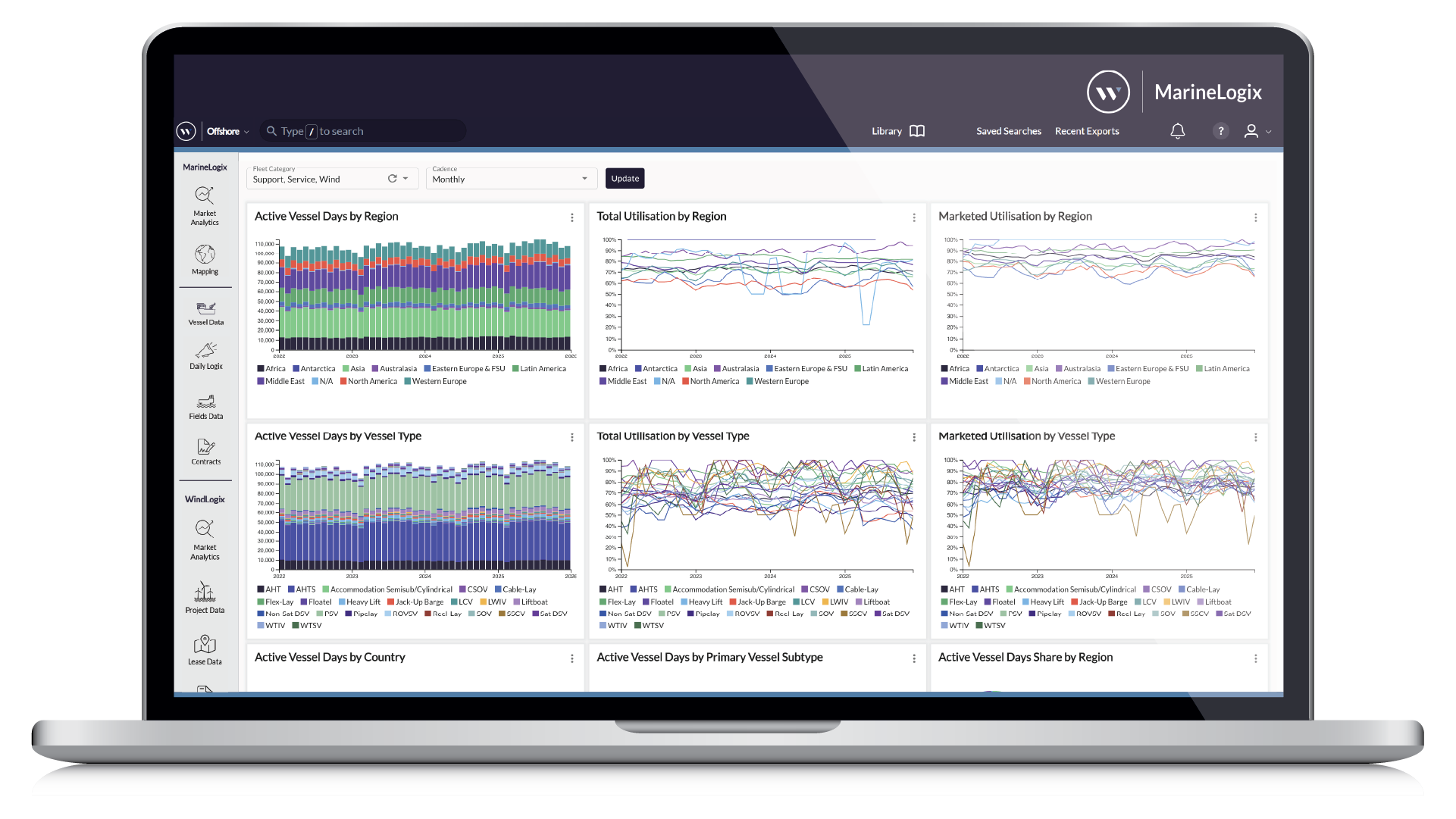
Historical Utilisation
Unique, purpose-built methodology to detect vessel activity and build a complete utilisation picture.
Active working days verified by our analysts for true benchmarking across regions, vessel classes and fleets.
Monitor high-performing fleets to inform deployment and newbuilding strategies.
Watch as Westwood’s Senior Manager – Offshore, Chen Wei, explains more.
With MarineLogix, historic utilisation is more than a metric.
MarineLogix uses a unique, purpose-built methodology to detect activity and build a utilisation picture. Behind every chart sits production scale automation that processes millions of AIS observations and transforms them into continuous, high‑quality activity timelines.
Our process detects start/stop behaviour, in‑transit vs stationary states, and regional switching, even bridging AIS gaps and obvious spoofing. Each vessel stop is then matched against Westwood’s proprietary spatial data – fields, licences, wind projects, ports and yards – creating energy‑sector‑specific utilisation, not generic movement.
The result is a normalised ‘active working days’ metric that allows true like-for-like benchmarking across regions, vessel classes and fleets – backed by fully explainable, traceable inferences our analysts can verify in seconds.


Do More with MarineLogix
Frequently Asked Questions
In the support fleet, what is the difference between an AHTS and PSV?
Anchor handling tug supply vessels (AHTSs) are designed primarily for the towage and anchor support of offshore drilling rigs and construction barges, typically differentiated by their power output, measured in either brake horsepower or bollard pull. More recently, they have found greater utilisation supporting floating production storage and offloading (FPSO) mooring systems or ongoing production operations as standby vessels.
Platform supply vessels (PSVs) provide offshore platforms and drilling rigs with critical consumables and supplies such as drilling muds, water and equipment. PSVs differentiate from AHTSs by having more dedicated tank storage, larger decks and lower fuel consumption.
MarineLogix tracks over 12 different types of support vessels, including AHTS, PSV, ERRV and Accommodation.
In the service fleet, what is a seismic research vessel?
Seismic/Research vessels are used to conduct marine seismic surveys for offshore oil and gas exploration and wind farm site characterisation. Equipped with advanced systems to generate and capture seismic waves, these vessels help map subsurface geological structures. They deploy air guns or other energy sources to emit seismic waves, which reflect off subsurface formations and are captured by long streamer arrays fitted with hydrophones to create detailed subsurface images.
MarineLogix tracks over 15 different types of service vessels, including Heavy Lift, Pipelay, DSV, ROVSV and Seismic.
In the wind fleet, what is the difference between a SOV and CSOV?
Service operation vessels (SOVs) provide walk-to-work (W2W) capabilities for wind farm operations and maintenance (O&M). SOVs provide accommodation for technicians and crew members and are equipped with an active heave-compensated gangway to transfer personnel safely between the vessel and the offshore platform. SOVs typically specialise in longer term contracts.
While similar to SOVs, commissioning service operation vessels (CSOVs) specialise in hook-up and commissioning works. CSOVs are generally larger than SOV counterparts in terms of both length and accommodation capacity. They may also include larger crane and remotely operated vehicle (ROV) capability.
MarineLogix tracks over 8 different types of wind vessels, including SOV, CSOV, WTIV and WTSV.
In the service fleet, what is a Heavy Lift vessel?
Heavy Lifts are monohull vessels equipped with high-capacity cranes rated above 3,000 metric tons, enabling them to handle large-scale lifting operations. Many are designed for dual functionality, incorporating both heavy lifting and pipelaying, making them versatile assets in offshore construction projects.
Heavy Lift Transportation vessels feature exceptionally large flush working decks and multi-level cargo holds to transport oversized and heavy cargo. Typical loads include petrochemical process equipment for refineries, transition pieces for offshore wind farms, and platform modules for oil and gas developments.
MarineLogix tracks over 15 different types of service vessels, including Heavy Lift, Pipelay, DSV, ROVSV and Seismic.
Vessel Intelligence That Makes a Difference
E&P Companies
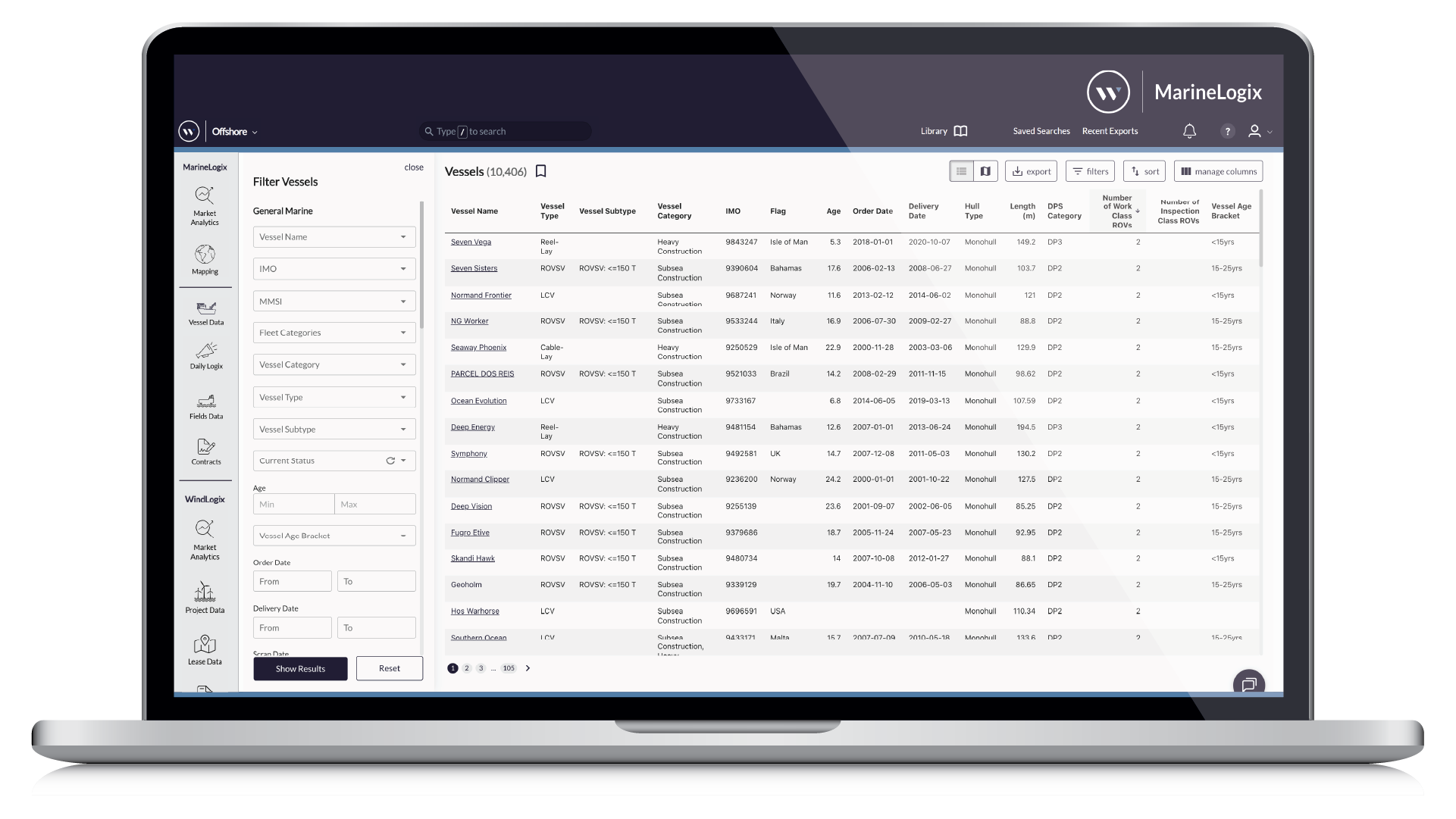
Use Vessel Search to identify and shortlist vessels by type and technical specifications required to support offshore operations planning and owner/manager engagement.
Vessel Owners
Use Historical Utilisation analytics to benchmark owned fleet activity days and utilisation rates against industry averages – by region and vessel class on a monthly, quarterly or annual basis.
Offshore Wind Farm Developers
Use Interactive Mapping to identify active vessels of interest and their proximity to offshore wind farm developments, enabling inference of operating areas and likely end-customers.
Government & Trade Organisations
Use Vessel Profiles to check build origin and flag to support local content compliance assessments by maritime authorities, with preference for domestically flagged vessels where capability exists.
Finance & Investment Firms
Use the Quarterly Market Report to assess key industry trends and market dynamics for the targeted vessel segment, providing visibility on the orderbook, supply tightness and demand outlook.
Original Equipment Manufacturers
Use DailyLogix to understand typical scope of work and equipment configurations associated with specific vessel owners or assets, while staying up to date with the latest offshore marine developments.
In a market currently defined by volatility and rapid change, MarineLogix delivers the clarity and depth needed to make confident, data-driven decisions. From fleet deployment to performance benchmarking, it offers a unified view of vessel activity, market dynamics and emerging opportunities across the global offshore marine landscape.
Chen Wei
Senior Manager - Offshore Marine, Westwood Global Energy Group







Speak to a specialist
Our specialist