

The global offshore support vessel (OSV) market continued its steady tightening through 2025, despite a challenging macro backdrop characterised by oil price weakness, geopolitical uncertainty and oversupply in crude markets.
Westwood’s new Global Offshore Support Fleet Market Report (4Q 2025) – available to MarineLogix subscribers – highlights how shifting fundamentals and a maturing fleet are shaping OSV dynamics in 2026 and beyond. Here we outline key findings from the inaugural report and what they mean for vessel owners, operators and offshore energy stakeholders.
Oil oversupply creates softer backdrop for 2026
Oil prices retreated from around $80 to $62/bbl through 2025 as global supply additions – notably from OPEC+, the US and Latin America – contributed over 4 mmbpd of incremental production and pushed the market into an average oversupply of 1.2 mmbpd.
Looking ahead, 1Q 2026 could see the largest imbalance since the COVID‑19 downturn, before gradually moderating across the year. Geopolitical volatility, including the removal of Venezuela’s Nicolás Maduro and civil unrest in Iran, adds further uncertainty to OPEC’s supply outlook.
While oil price softness typically feeds into offshore activity with a lag, the OSV market enters 2026 with momentum supported by vessel scarcity, improving requirements, and multi‑year offshore investment cycles in key regions.
EPCI spending rebounds, tailwind for OSV demand
Offshore engineering, procurement, construction and installation (EPCI) expenditure totalled US$259bn between 2022 and 2025, easing to US$54bn in 2025 as project deferrals and macroeconomic caution slowed final investment decisions. However, the outlook brightens meaningfully in 2026, with spending projected to rise 32%, reaching US$71bn before stabilising at levels above 2025.

Global Offshore EPCI Investment Outlook
Source: Westwood SubseaLogix & PlatformLogix
Key regions for growth are West Africa and Latin America. Notable projects include TotalEnergies’ Venus Phase I (Namibia) development with an estimated cost of US$3bn for a newbuild FPSO, as well as ExxonMobil’s Longtail (Guyana) development. South Africa is also emerging as a frontier for large scale offshore oil developments.
These investment flows translate into long-term demand for platform supply vessels (PSVs), anchor handling tug supply vessels (AHTSs), and tonnage capable of supporting complex installation and field development campaigns.
Offshore rig market moderates but remains supportive
Rig activity softened marginally across jackups, semisubmersibles and drillships in 2025. Average committed jackups closed the year at around 397 units – a 4% YoY decline – largely attributed to Saudi Aramco’s phased suspensions since April 2024. Meanwhile semisubs closed at around 62 committed units with a 7% YoY drop, and drillships averaged 81 committed units at the end of 2025, representing a 1% YoY decline.
Despite these small declines, offshore rig dayrates remained strong, with jackups averaging $94k/day, semisubs fixing at around $375k/day and drillships $430k/day.
This stability reflects a market that has rebalanced post COVID, with high-spec units in particular benefitting from tight availability. Offshore drilling trajectories continue to support OSV demand across logistics, anchor handling and rig move support.
Global OSV demand continues to outpace supply
Demand for the OSV fleet grew 2% YoY in 2025, supported by robust activity in three key regions (with accompanying activity shares) – the Middle East (19% of demand), Latin America (16%), and Southeast Asia (14%). Marketed utilisation averaged 76% for the year, with total fleet utilisation at 71%. Westwood expects marketed utilisation to strengthen to 77% in 2026, then exceeding 79% in 2027 as fleet availability tightens.
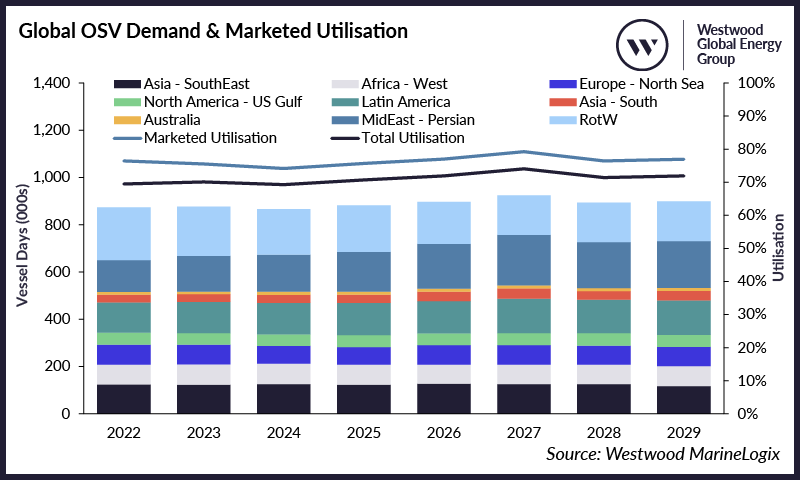
Global OSV Demand & Marketed Utilisation
Source: Westwood MarineLogix
Fleet composition and reactivations
The global operational fleet expanded to 3,209 vessels in 4Q 2025, while the laid‑up fleet fell slightly to 377 vessels. However, the age profile continues to shift – vessels over 15 years old now represent a larger share of the operational fleet than newer tonnage.
Regional movements highlight ongoing redistribution, with South Asia and West Africa receiving the highest influx of vessels during the quarter, while the North Sea had the highest outflow of 20 vessels.
Orderbook remains limited relative to active fleet
As of 4Q 2025, the global OSV orderbook stands at 216 vessels, of which 57% are for AHTSs and 43% for PSVs. Compared to the pace of offshore activity growth, the orderbook remains structurally low, supporting the multi‑year tightening theme that has characterised the post‑pandemic OSV recovery.
The aging fleet and limited newbuild appetite underscore a tightening supply outlook – particularly for modern, fuel‑efficient vessels aligned with charterer expectations.
What this means for the OSV market beyond 2026
Despite macroeconomic pressures and a softening oil price environment, the OSV market continues to tighten, driven by structural fleet constraints, strong regional pockets of demand and a wave of offshore EPCI investment returning in 2026. With marketed utilisation set to rise again and the fleet aging faster than it renews, vessel availability is expected to remain a central challenge for charterers into 2027.
For vessel owners, operators and investors, insight‑led decisions are essential – and MarineLogix provides the integrated intelligence needed to navigate this complex and fast‑moving market.
How MarineLogix supports market interpretation
This analysis forms part of the quarterly market report included in the MarineLogix subscription, which also provides:
- Global vessel demand and utilisation analytics
- Vessel specifications, ownership and tracking
- Daily fleet movements and proximity tools
- Integrated offshore oil and gas infrastructure mapping
MarineLogix brings together AIS intelligence, vessel specifications, utilisation analytics and market insights – giving subscribers a unified, data‑driven view of the offshore marine landscape.
Chen Wei, Senior Manager – Offshore Marine
[email protected]