
Africa and South America are expected to remain the dominant regions for high impact drilling with 19 and 15 wells respectively in 2026.
Westwood forecasts around 65 high impact wells to complete in 2026, in-line with 2025. While drilling plans continue to firm up throughout 1Q 2026, current projections suggest that the observed slowdown in high impact exploration drilling will continue. Explorers are exercising capital discipline in the current price environment whilst building their acreage portfolios to create future optionality.
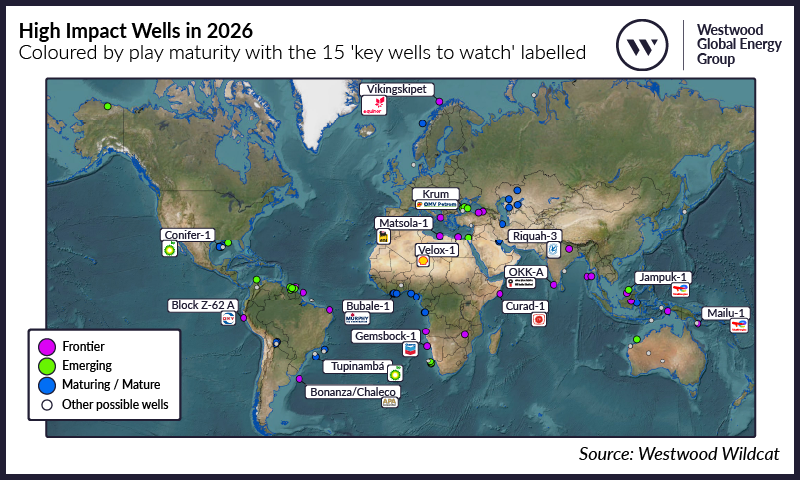
High Impact Wells in 2026: Westwood has identified 15 key wells to watch
Source: Westwood Wildcat
Africa: Five key frontier basin tests
In Africa, four wells are expected in the Orange Basin in Namibia and Chevron plans to drill Gemsbock, the first well in the frontier Walvis Basin since 2018. Four wells are due to complete in the Tano-Ivorian Basin with three by Murphy, with the unsuccessful Civette well completing in January 2026, Caracal currently drilling and Bubale expected to spud later in the first quarter. 2026 will also see key frontier basin tests include Eni’s Matsola well in the offshore Sirte Basin, TPAO’s Curad-1 offshore Somalia, Shell Velox’s well in the Herodotus, and Azule’s Piambo well in the Namibe.
South America: Suriname takes lion’s share
In South America, the Suriname-Guyana Basin and the Santos and Campos basins in Brazil will continue to host the majority of the high impact drilling from the region. Suriname is expected to see the lion’s share of exploration drilling compared to Guyana where recent focus has been on appraisal and progressing developments in the Stabroek licence. Petronas is expected to lead the high impact drilling in Suriname with at least two wells. Shell recently completed drilling at its unsuccessful Araku Deep well targeting a frontier Lower Cretaceous clastic play on the Demerara Plateau. In the Santos Basin, BP’s Tupinamba is a key well to watch targeting a large pre-salt prospect next door to its giant Bumerangue discovery, made in 2025. Elsewhere across South America, key frontier wells could be drilled in deepwater Uruguay and offshore Peru. The frontier deepwater of Brazil’s Equatorial Margin is expected to be a focus area for Petrobras, with Morpho currently drilling in the Foz do Amazonas. Further southeast in the Potiguar Basin, Petrobras will drill the Mãe de Ouro well, a follow up to the 2024 Anhanga discovery.
Asia Pacific: Long delayed Mailu-1 to be drilled
In Asia Pacific, 10-12 high impact wells are expected in 2026. Key frontier deepwater carbonate tests are expected offshore Papua New Guinea at Mailu and in deepwater Malaysia at Jampuk and Langka. Petronas may spud its first frontier well at Akbar-1 in the Bobara PSC, eastern Indonesia, ending a 12-year frontier deepwater drilling hiatus in the region. Eni continues its exploration programme in the Kutei Basin, Indonesia, where it is currently drilling a large Miocene fan prospect at Geliga. In India, ONGC and Oil India will finish their Andaman and Kerala-Konkan frontier campaigns in early 2026, with the next high impact campaign likely to be Vedanta’s (Cairn India) deepwater Krishna-Godavari drilling in KG-DWHP-2017/1. In Australia, Santos is expected to make the long-awaited return to exploration in the Roebuck Basin targeting potential Triassic plays at Curie and Ara from late 2026.
Russia, Middle East & Central Asia: Kuwait under spotlight
High impact wells are expected in Uzbekistan, Kazakhstan, Kuwait, Iran and Turkey. Offshore Kuwait, KOC’s Riquah-3 is a key well to watch and follows on to the largest discovery of 2024 (Al Nokhetha). The well is targeting a deeper Jurassic play in the sparsely explored offshore. Limited activity continues in Russia, with Kontrovichskoye recently being announced in the Yamal Peninsular.
Europe: Western Black Sea becoming a hotspot
In Europe, six high impact wells are expected in 2026. Equinor’s Vikingskipet well in the Norwegian Barents Sea was a key well to watch and completed in mid-February as a dry hole. Other planned high impact wells in Norway include Var Energi’s Lakris and Aker BP’s Alpehulme. In the Bulgarian Western Black Sea, OMV Petrom will drill the Krum well, which is a key test of the emerging Upper Miocene and Pliocene turbidite play following the Vinekh failure earlier in 2026. Across the border in Romania OMV Petrom also plans to drill the Anaconda prospect ~37km south of the Domino gas field.
North America: High impact drilling subdued
High impact drilling in North America will remain subdued with around five high impact wells expected. BP’s Conifer-1 targeting a large prospect in the US Gulf is a key well and 2026 will mark BP’s long anticipated return to the Paleogene. BP also plans to drill a potential high impact ILX prospect on the NW flank of the Kaskida discovery, and Shell, Chevron and TotalEnergies are all expected to drill high impact wells in the US Gulf. No high impact wells are expected to complete on Alaska’s North Slope, or in Eastern Canada in 2026.
Jamie Collard, Exploration Research Manager
[email protected]
Westwood’s Global E&A team are hosting their annual Key Wells to Watch webinar on Tuesday 24 February (public session), summarising high impact exploration drilling in 2026. Register here