

Westwood’s Global Subsea Tree Tracker
Each month Westwood’s subsea team provides a global update on subsea tree awards, with data sourced from and analysed using, SubseaLogix. Bookmark this page for regular updates on the health of the subsea oil and gas sector.
Updated – 6th June, 2026
Ivory Coast: Eni sanctioned its Baleine Ph.3 development, increasing oil production from 60 kbpd to 150 kbpd and gas production from 80 mmcfd to 200 mmcfd, with production starting in 2030.
Brazil: In its 1Q 2026 investor presentation, BW Energy stated it had sanctioned its Golfinho infill project, comprising three infill wells and tying back one existing well from the Camarupim field, which has been idle since 2015.
USA: BP announced a final investment decision (FID) for the Thunder Horse subsea pump project, with operations expected to commence in 2028, raising peak gross annual average production to approximately 15 kboepd.
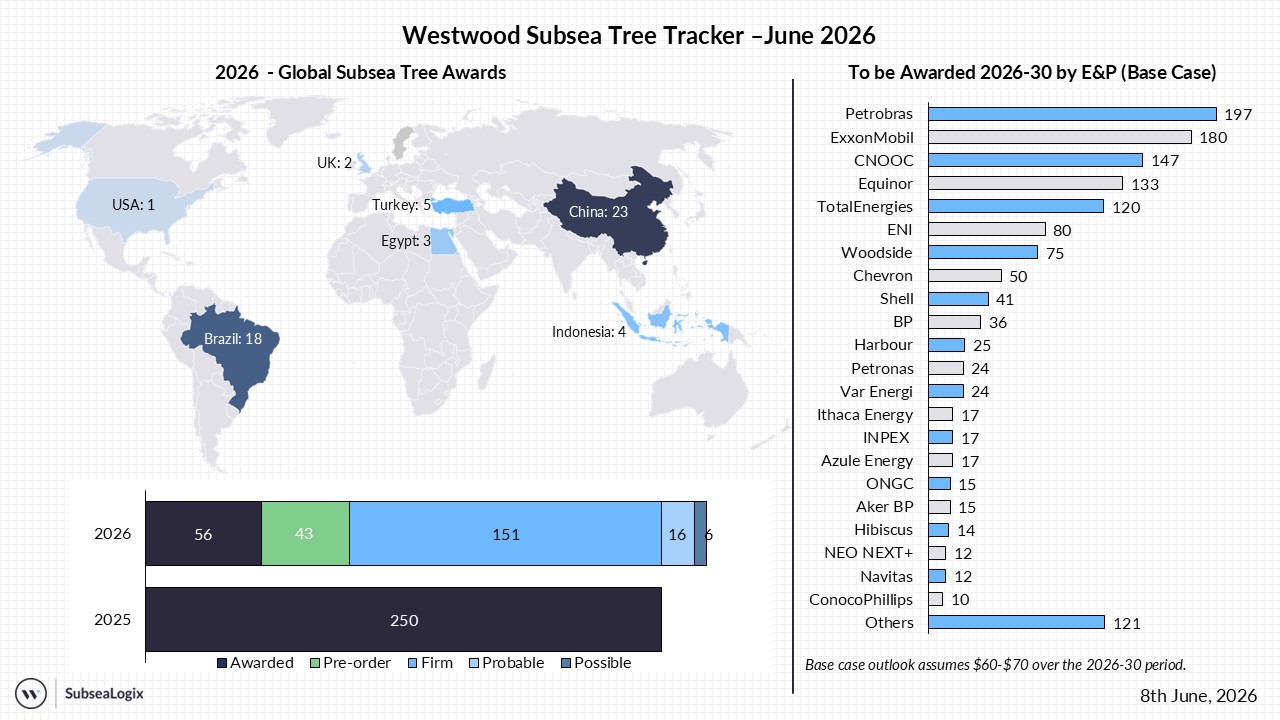
- Westwood anticipates approximately 90 subsea tree units to be awarded in 2Q 2026, with Eni accounting for 35%, driven by its recently sanctioned Baleine Ph. 3 development (Ivory Coast), the Geng North Development (Indonesia) and the Cronos gas field (Cyprus). Other key projects expected to be sanctioned before the end of the quarter include Azule Energy’s PAJ project offshore Angola, Var Energi’s Balder Next project (Norway), and Equinor’s Troll West IGR North (TWIN) offshore Norway.
- Subsea tree awards in 2026 appear somewhat constrained, although attributing this directly to the Iran conflict is only partially supported. Whilst the war has introduced heightened geopolitical risk, supply chain disruption, and price volatility, subsea tree awards recorded ytd still represent a 33% YoY increase. Overall, 2026 subsea tree demand is estimated at 274 units, representing a 10% increase from 2025, with key projects such as ExxonMobil’s Longtail development (Guyana), TotalEnergies’ Venus (Namibia), and several subsea tieback projects offshore Norway, supporting an expected buoyant 2H 2026 subsea tree outlook.
- Our visible base‑case outlook for subsea tree demand between 2026 and 2030 remains unchanged at approximately 1,380 units. However, upside remains with projects such as Petrobras’ Curacao and Tortuga Leste discoveries in the Aram pre-salt block, given the recent review of a potential standalone development for up to two FPSO units.
Mark Adeosun
Director, SubseaLogix
[email protected]
Updated – 6th May, 2026
USA: Kosmos Energy announced the final investment decision (FID) for its Tiberius field in the Gulf of America, indicating FID was taken in March 2026. Production is scheduled to commence in 2H 2028, with long-lead items already secured and most of the capital expected in 2027 and 2028.
Brazil: Petrobras has sanctioned its Sergipe-Alagoas Deepwater (SEAP)-1 project, with production expected to commence in 2031 via the P-81 FPSO.
Timor Leste: Finder Energy has reportedly reserved three subsea trees for its Kuda Tasi and Jahal (KTJ) development, with a final investment decision (FID) anticipated in mid-2026.
Nigeria: Following the resolution of a dispute centred on Oil Prospecting License (OPL) 245, Eni’s Zabazaba field offshore Nigeria is now set for full development via an FPSO and 22 subsea trees installed over two phases.
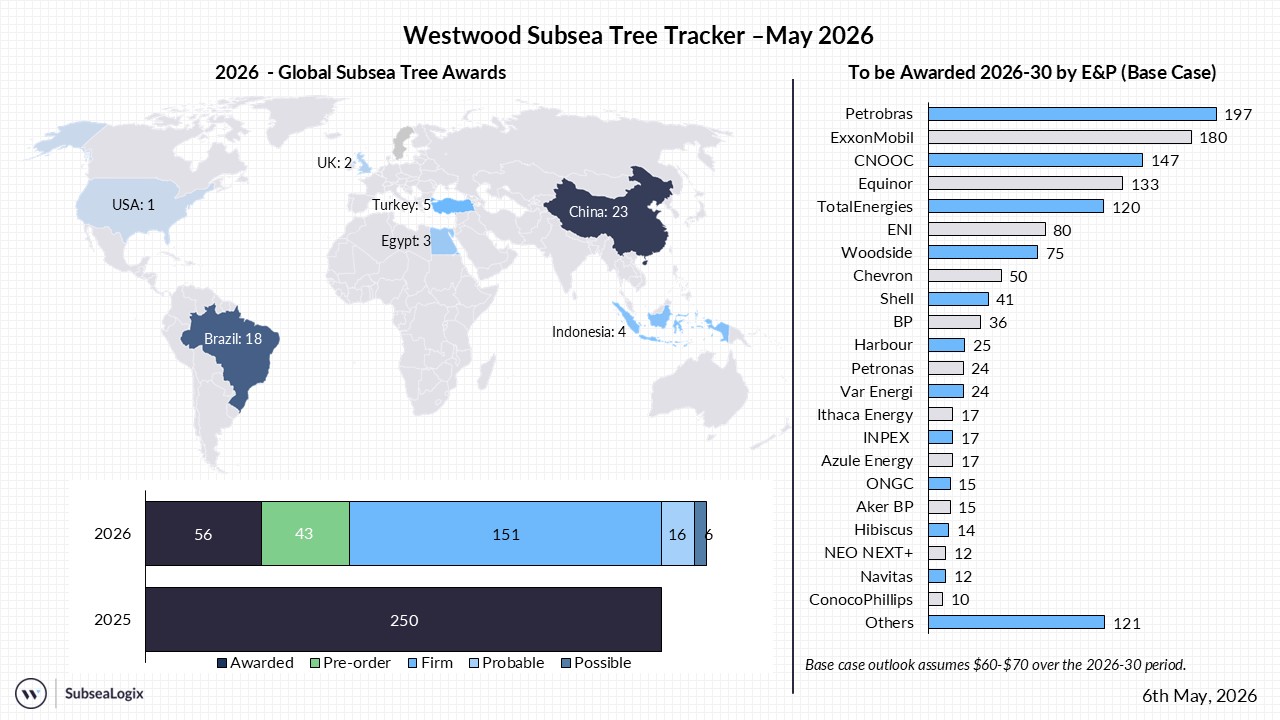
- No subsea tree contracts were announced in April 2026. However, in its 1Q 2026 results, Innovex reported awards for two significant subsea projects in Asia, including shallow water tree systems. Westwood forecasts that total subsea tree demand for 2026 will total 274 units, with only 56 units (20%) already awarded year-to-date. Key subsea tree awards expected to be confirmed in 2Q include unit work scope for the recently sanctioned Eni’s Geng North project (Indonesia), Baleine Ph.3 (Ivory Coast), and additional subsea tree callouts from Petrobras’ existing Global Frame Agreement with Baker Hughes and TechnipFMC.
- Our visible base‑case outlook for subsea tree demand between 2026 and 2030 is estimated at c.1,380 units, averaging around 276 units annually.
Mark Adeosun
Director, SubseaLogix
[email protected]
Updated – 6th April, 2026
Indonesia: Eni has taken the final investment decision (FID) for its Geng North and Gendalo–Gendang gas developments in the Kutei Basin. Both projects are scheduled to come online in 2028 and are expected to reach a combined peak output of 2 bcfd of gas and 90 kbpd of condensate by 2029.
China: The OneSubsea joint venture has secured an integrated multi‑well engineering, procurement, and construction (EPC) contract from CNOOC to supply 20 subsea trees for the Kaiping 18‑1 development.
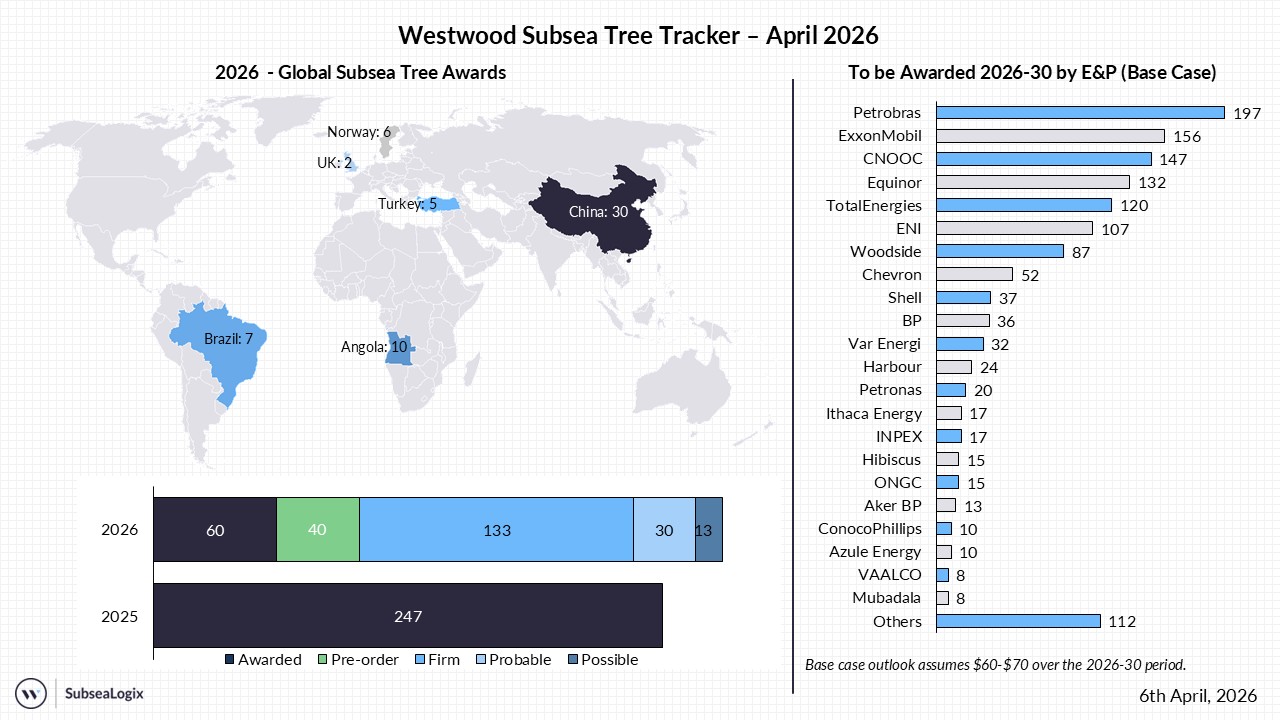
- Year‑to‑date subsea tree awards have reached 60 units, with CNOOC’s Kaiping 18‑1 development standing out as the most significant award during the review period. Looking ahead to 2Q 2026, key subsea tree contract decisions to monitor include the recently sanctioned Eni Geng North and Gendalo–Gendang gas developments offshore Indonesia, additional call‑offs under Petrobras’ global frame agreements with Baker Hughes and TechnipFMC for Brazilian projects, and Conrad’s Mako gas field offshore Indonesia.
- Our base‑case outlook for subsea tree demand between 2026 and 2030 is estimated at c.1,375 units, averaging around 275 units annually. Activity offshore Brazil, Norway, and Nigeria is expected to contribute about 40% of total demand, while developments offshore Australia, China, and Guyana are each projected to require more than 100 subsea trees through 2030.
Mark Adeosun
Director, SubseaLogix
[email protected]
Updated – 6th March, 2026
Indonesia: Conrad Asia Energy has announced the final investment decision for its Mako field, with an estimated total development of US$320 million. The initial phase will include six subsea wells tied back to a leased Mobile Offshore Production Unit.
Nigeria: Following the conversion of OPL 245 into two Petroleum Mining Leases (PML 102 and PML 103) and two Petroleum Prospecting Leases (PPL 2011 and PPL 2012), Eni has indicated plans to fast-track the development of the long-delayed Etan-Zabazaba project.
Nigeria: Shell is progressing with the tender process for the subsea equipment required for the long-delayed Bonga South-West development. The first phase of the project will require 23 subsea trees, with FID targeted for 2027.
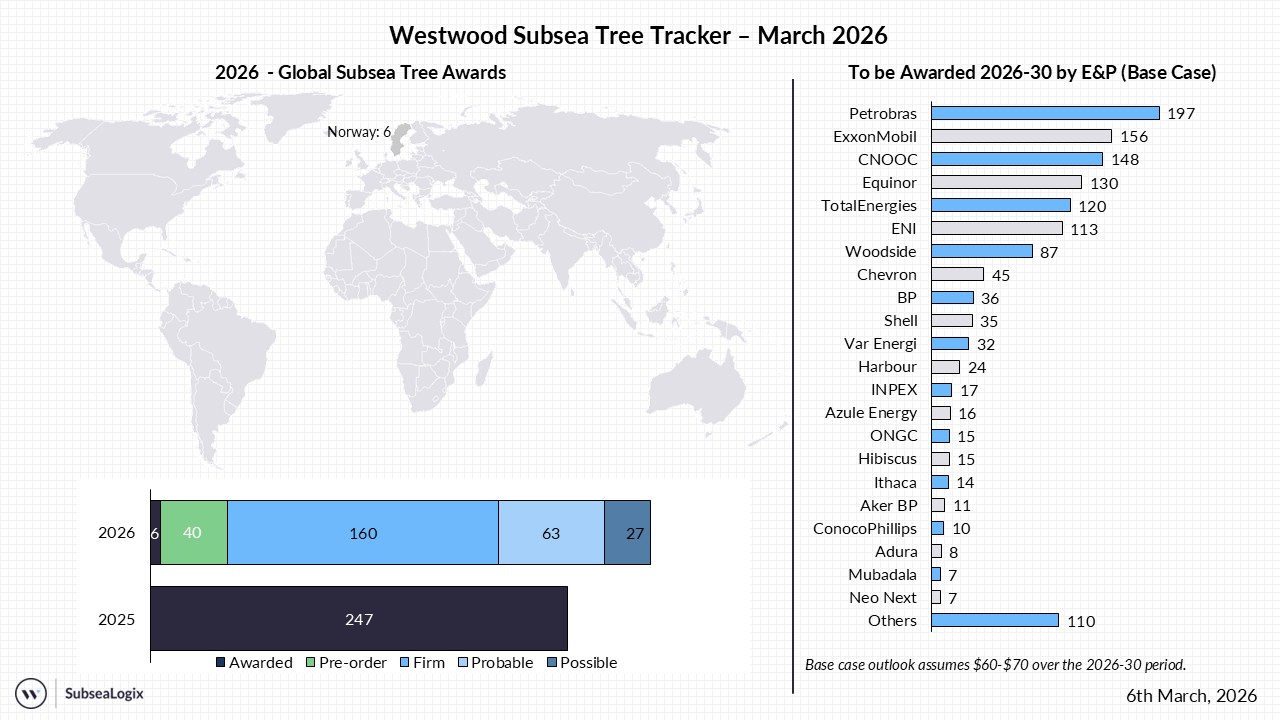
- No subsea tree contract award was announced in February 2026. However, Westwood forecast subsea tree demand in 2026 at 296 units, with key projects such as Petrobras’ SEAP II and Buzios-12 (Brazil), TotalEnergies’ Venus development (Namibia), and ExxonMobil’s Longtail project (Guyana) underpinning demand.
- CNOOC’s Kaiping 18‑1 and 11‑4 developments (China), TPAO’s Goktepe (Turkey), Chevron’s Agbami Infill drilling (Nigeria) and Eni’s Geng North development offshore Indonesia remain key projects to watch in 1Q 2026.
- Our visible base-case demand outlook for subsea tree units over the 2026-2030 period is estimated at c.1,350 units, a 5% increase compared to last month’s outlook. The uplift is predominantly driven by potential fast-track development of Eni’s Etan-Zabazaba development offshore Nigeria, following the conversion of the Oil Prospecting Licence (OPL) 245 to Petroleum Mining Leases (PML) 102 and 103. Furthermore, TotalEnergies also plans to sanction its Mopane field offshore Namibia before the end of the decade, after agreeing to a cash‑free asset swap with Galp Energia.
Mark Adeosun
Director, SubseaLogix
[email protected]
Updated – 6th February, 2026
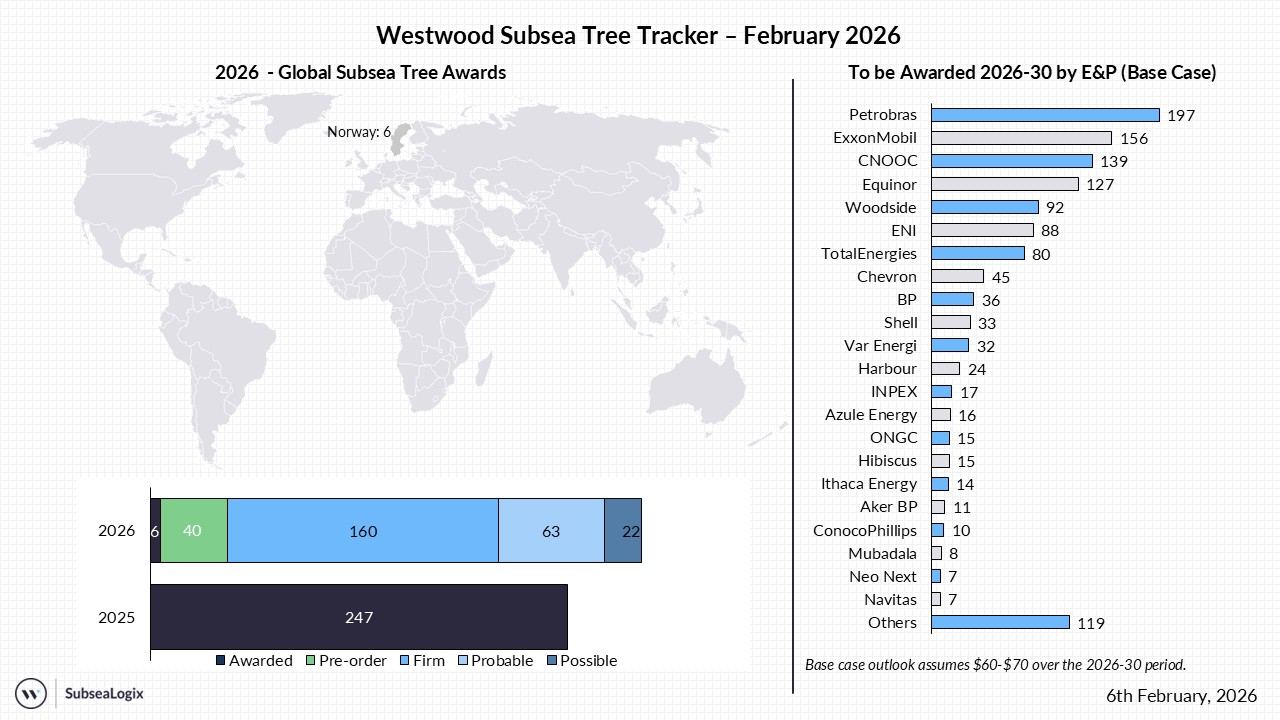
Israel: Chevron announced the final investment decision for its Leviathan Expansion project, which will involve three additional subsea wells.
Norway: Kistos Energy reported that FID has been achieved for Var Energi’s Balder Next Project.
Norway: Equinor confirmed it awarded OneSubsea a contract for a subsea production system (SPS) at its Isflak field. The contract, valued at approximately US$69.3 million, was awarded in 4Q 2025.
- No subsea tree contract award was announced in January 2026. However, Westwood anticipates tree award for Var Energi’s Balder Next project offshore Norway will support supply contract for up to six subsea trees in 1Q 2026.
- Key subsea tree contract awards to watch in 1Q 2026 include CNOOC’s Kaiping 18‑1 and 11‑4 developments (China), TPAO’s Goktepe (Turkey), Azule Energy’s PAJ Field and Eni’s Geng North development offshore Indonesia.
- Our visible base-case demand outlook for subsea tree units from 2026 to 2030 remains unchanged from last month’s forecast at c.1,290 units, averaging 260 units a year, with ExxonMobil and Petrobras will account for 27% of forecast demand, underpinned by driven by 16 FPSO units anticipated to be sanctioned in the Stabroek Basin offshore Guayana and Petrobras’ continued investment in its pre-salt Basin.
Mark Adeosun
Director, SubseaLogix
[email protected]
Updated – 6th January, 2026
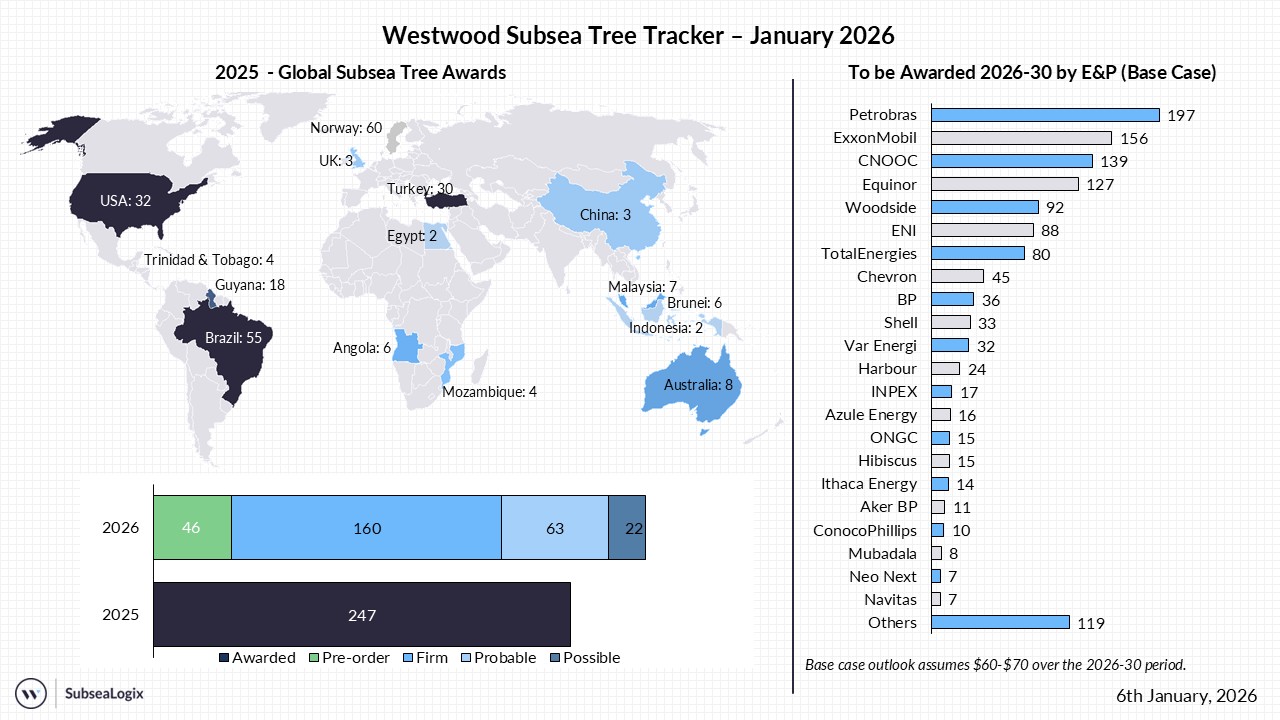
US: TechnipFMC secured an integrated EPCI contract from BP for the Tiber development in the US Gulf, valued between US$600 million and US$800 million.
Brazil: Petrobras confirmed FID for the SEAP-2 project, with first oil targeted for 2030. Westwood expects subsea tree demand to be met through existing frame agreements with Baker Hughes and TechnipFMC.
Norway: ConocoPhillips approved the Previously Produced Fields (PPF) redevelopment project, which covers the Albuskjell, Vest Ekofisk, and Tommeliten Gamma fields. The plan includes the use of 12 subsea wells.
US: Shell has sanctioned a waterflood development at the Kaikias field in the Gulf of America. Westwood forecasts the use of three subsea wells, with first water injection anticipated in 2028.
Australia: TechnipFMC received a contract to supply horizontal subsea trees for Chevron’s Gorgon Stage 3 project.
Falkland Islands: Rockhopper Exploration reported that FID has been achieved for Navitas Petroleum’s Sea Lion development.
- Subsea tree awards in 4Q 2025 closed at 74 units, representing an 30% QoQ decline. This brings full-year 2025 award to approximately 247 units, a 10% YoY decline. Key awards recorded in December include supply contracts for Chevron’s Gorgon Stage 3 and BP’s Tiber development in the US, along with additional callouts under Petrobras’ global frame agreements.
- Westwood’s 2026 subsea tree demand outlook is forecast at approximately 291 units, driven by activities offshore Brazil, Norway, Namibia, and Guyana, based on a $60-$70/bbl Brent oil price. Based on our assessment of subsurface, commercial, and geopolitical factors, we categorize the anticipated tree awards as follows: 160 units (55%) are classified as “Firm”, 63 units (22%) as “Probable”, and 22 units (8%) are classified as “Possible”, with 46 units already issued with a letter of intent (LoI).
- Looking ahead, base‑case demand for subsea trees from 2026–2030 is estimated at 1,290 units, averaging 260 units annually, aligned with the 2021–2025 yearly average.
Mark Adeosun
Director, SubseaLogix
[email protected]